




Image

How to start a business in the supplement market: everything you need to know before launching your brand 

October 17th, 2025

Reading Time: 6 minutes

October 17th, 2025

Reading Time: 6 minutes

ImageImageImageImageImage
Home » Blog » Business » How to start a business in the supplement market: everything you need to know before launching your brand 

How to start a business in the supplement market: everything you need to know before launching your brand 


In recent years, Brazil has established itself as one of the largest global hubs for consumption and innovation in dietary supplements. This evolution reflects a clear shift in consumer behavior: culture of well-being.

According to Industrial System Observatory Network, this trend should shape consumption until 2040, boosting new ingredients, technologies and nutritional formats.

Therefore, to grow in this market, entrepreneurs need more than just willpower. It's necessary strategy, mastery of regulatory requirements and technical partners.

How does the supplement market work in Brazil? 

The supplement and vitamin sector in Brazil is experiencing a phase of accelerated expansion and maturity. According to data from InterPlayers, between March 2024 and February 2025, the market grew 37% in volume e 29% in revenue.

Furthermore, Brazil has consolidated itself among the three largest supplement consumer markets in the world, with a turnover that reached BRL 4,6 billion in 2024.
With this rate of growth, the sector should reach R$9,6 billion by 2028, a rise of 120%.

Currently, two out of every three Brazilian homes have someone who uses some type of supplement, which shows how supplementation is already part of the population's health routine.

A growing sector with strong regulation 

A Brazilian legislation is among the strictest in the world when it comes to dietary supplements and the consumer already recognizes this rigor as a essential value.

77% of Brazilians have stopped buying supplements due to a lack of clear information about safety and effectiveness, and 58% value scientific certifications and quality tests.
Source: Minds & Hearts

This scenario reflects a growing demand for transparency and control.
Therefore, the Anvisa (National Health Surveillance Agency) acts with technical rigor in all stages of the production process, from the choice of ingredients to the final labeling, ensuring that each product is safe and technically validated.

Among the main regulatory requirements are:

  • Prior notification in the Anvisa system before marketing; 
  • Stability studies, which prove the maintenance of nutritional properties throughout the shelf life; 
  • Positive ingredient lists and usage limits, which restrict what can (or cannot) be used;
  • Mandatory and standardized labeling, with clear information on consumption, restrictions and composition;  
  • E continuous monitoring, with suspension and collection of irregular products. 

In this context, launching a supplement brand requires not only investment, but technical responsibility and regulatory compliance. Thus, in a fast-growing sector, the credibility becomes the greatest competitive advantage.

Food supplement vs. Food preparation powder

Within the regulations of Anvisa, products can fall into two main categories: food supplement ou powder for food preparation. The difference is in the level of technical requirement and in the regulatory process.

Os food suplements need to go through stability studies, which prove the maintenance of nutritional properties throughout the validity period, a process that usually retain the product for at least 6 months before launch.

The food preparation powders do not require this step; they just need to be in compliance with Anvisa safety and labeling standards, which allows a shorter release time.

Best-selling supplements in 2025

O Brazilian supplement market continues to rise strongly and, each year, new categories are consolidated while others gain strength among consumers. According to the Close-Up International Sports Supplements Report, the sector moved R $ million 723 only in the pharmaceutical channel, which represents a significant advance in 66,6% compared to the previous period.

This performance reflects a more informed and demanding consumer, who seeks products with proven efficacy, safety and functional purpose. Furthermore, the growth in sales indicates a significant change in behavior: supplements are no longer seen solely as sports support and have become part of wellness and self-care routines.

In this scenario, two categories stand out as symbols of the sector's maturity and the new consumer mentality.

Creatine: the engine of expansion 

Creatine sales increase by 137,4% in 2025

In 2025 the creatine assumed the leading role in growth. Recognized for being a quick energy source for muscles, which improves strength and performance in high-intensity exercises, she recorded a 137,4% increase in salesThis leap goes beyond academia.

As a result, consumers began to see the supplement as performance and longevity tool, and not just aesthetics. Consequently, creatine has become the gateway for a generation seeking measurable results and scientific support, consolidating its presence on shelves and in consumers’ daily lives.

Whey protein: the absolute leader 

Even with the advancement of creatine, the whey protein remains as the pillar of the Brazilian market, responsible for 45,1% of total revenue. According to Mordor intelligence, Brazil represents 58% of the South American market and should grow, on average, 8% per year until 2029.

On the other hand, whey's success goes far beyond the sports world.
It symbolizes the fusion of nutrition and convenience, with high biological value, excellent digestibility and a complete profile of essential amino acids such as leucine, valine and lysine.
Thus, the product became the basis of national consumption e the starting point for many new brands that enter the market.

The other categories that keep the pace 

According to the Panorama of Abiad, Brazilian consumers remain loyal to categories with strong appeal to prevention and well-being:

  • Multivitamins and minerals, for its practicality and preventive function;
  • Omega-3 and essential fatty acids, focused on cardiovascular and cognitive health;
  • Collagen and nutricosmetics, associated with aesthetics and longevity;
  • Vitamins C and D, reinforced by the role in immunity;
  • Functional supplements, such as those focused on focus and disposition.

In this way, the Brazilian market shows that it is growing in volume, quality and consumer awareness. The public seeks science, functionality and real user experience e, that is why, brands that combine innovation and technical responsibility are the ones that stand out the most.

💡Want to understand which brands are standing out in each segment?
Check out the full article on the best supplement brands by category in 2025

How much does it cost to manufacture supplements? 

Talking about cost is, in practice, talking about business model and positioning strategy
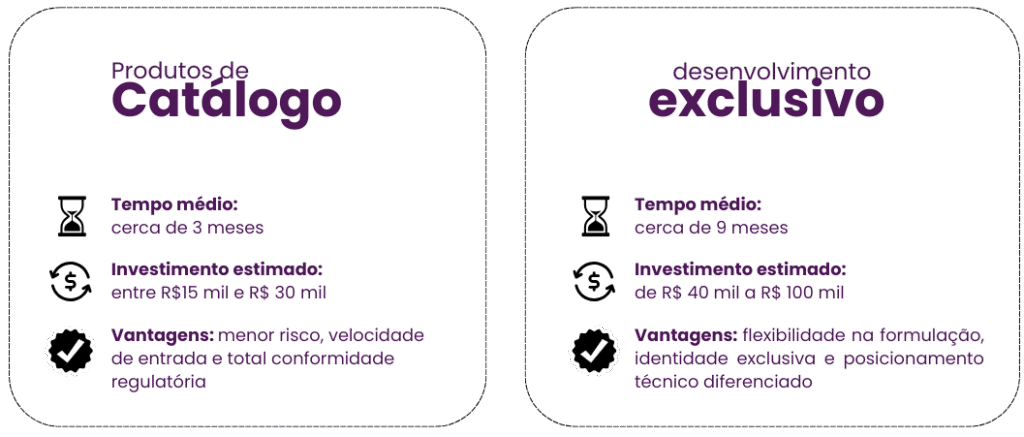
In Brazil, the investment to launch a supplement can vary between R$15 and R$100 per product, depending on the type of formulation, initial batch, packaging, testing and regulatory notifications. 

The key point is in the choice of manufacturing model and understand which one makes the most sense for the brand moment and objective

White label: the model for those who want agility and structure 

The white label allows a brand to market products developed and manufactured by a specialized industry with your own visual identity and positioning.
In this format, the entrepreneur has the entire technical, regulatory and productive structure from the factory, but keeps autonomy in brand management and relationships with the public.

A Pronutrition, for example, ensures that the entire process follows Good Manufacturing Practices (GMP) e Anvisa standards, from formulation to labeling. Thus, the entrepreneur does not need to deal directly with regulatory complexity, being able to focus on strategy, positioning and growth.

Products cataloged, Ou seja, formulations already developed and tested by the technical team, are one of the most agile ways to get started, offering safety, quality and optimized investment.

Exclusive development: the model for those who want customization

O exclusive development is aimed at brands that want create original products with own formulas and differentials, exploring new concepts and assets. 

Here the product is created from scratch: from composition and stability testing to flavor, texture, and final packaging. It's a more detailed process, but it allows you to build solutions with Clear brand DNA and technical purpose

What are the main differences between exclusive development and white label?

Can you start small without losing quality? 

Yes, as long as the process is conducted with technical rigor and industrial responsibility
In the supplement market, starting small doesn't mean starting weak
With the right outsourcing model and the support of a structured industry, it is possible to launch a brand with pharmaceutical standard, quality control and regulatory support, even in the early stages. 

A Pronutrition acts precisely at this point: helping the entrepreneur to enter the market safely, offering technical support in formulation, labeling, regulatory compliance and development of products with high sensory and scientific performance. 

Consistent growth starts with the first batch and is only possible when the product is born within the correct standards. 

By choosing a solid partnership, the entrepreneur gains what matters most in the early stages of the business: peace of mind to test, learn and build a credible brand

How to choose a reliable supplement factory 

Choosing the right factory is the most strategic decision of the entire journey. 
More than a supplier, you need a partner that understands your business and help you grow safely. 

Before entering into a partnership, evaluate whether the industry: 

  • It has Good Manufacturing Practices (GMP) certification
  • It is regularized by Anvisa
  • Offers reliable, technical and regulatory support
  • works with transparency in formulations and deadlines
  • Has client history and solid portfolio

A reliable factory not only produces, she co-constructs

And it is in this role that the Pronutrition acts: as a strategic partner, combining technical rigor, innovation and business vision.  The goal is not just to manufacture supplements, but to help brands grow with consistency, performance and purpose. 

ImageImageImageImageImageImage
Home » Blog » Business » How to start a business in the supplement market: everything you need to know before launching your brand 

How to start a business in the supplement market: everything you need to know before launching your brand 


In recent years, Brazil has established itself as one of the largest global hubs for consumption and innovation in dietary supplements. This evolution reflects a clear shift in consumer behavior: culture of well-being.

According to Industrial System Observatory Network, this trend should shape consumption until 2040, boosting new ingredients, technologies and nutritional formats.

Therefore, to grow in this market, entrepreneurs need more than just willpower. It's necessary strategy, mastery of regulatory requirements and technical partners.

How does the supplement market work in Brazil? 

The supplement and vitamin sector in Brazil is experiencing a phase of accelerated expansion and maturity. According to data from InterPlayers, between March 2024 and February 2025, the market grew 37% in volume e 29% in revenue.

Furthermore, Brazil has consolidated itself among the three largest supplement consumer markets in the world, with a turnover that reached BRL 4,6 billion in 2024.
With this rate of growth, the sector should reach R$9,6 billion by 2028, a rise of 120%.

Currently, two out of every three Brazilian homes have someone who uses some type of supplement, which shows how supplementation is already part of the population's health routine.

A growing sector with strong regulation 

A Brazilian legislation is among the strictest in the world when it comes to dietary supplements and the consumer already recognizes this rigor as a essential value.

77% of Brazilians have stopped buying supplements due to a lack of clear information about safety and effectiveness, and 58% value scientific certifications and quality tests.
Source: Minds & Hearts

This scenario reflects a growing demand for transparency and control.
Therefore, the Anvisa (National Health Surveillance Agency) acts with technical rigor in all stages of the production process, from the choice of ingredients to the final labeling, ensuring that each product is safe and technically validated.

Among the main regulatory requirements are:

  • Prior notification in the Anvisa system before marketing; 
  • Stability studies, which prove the maintenance of nutritional properties throughout the shelf life; 
  • Positive ingredient lists and usage limits, which restrict what can (or cannot) be used;
  • Mandatory and standardized labeling, with clear information on consumption, restrictions and composition;  
  • E continuous monitoring, with suspension and collection of irregular products. 

In this context, launching a supplement brand requires not only investment, but technical responsibility and regulatory compliance. Thus, in a fast-growing sector, the credibility becomes the greatest competitive advantage.

Food supplement vs. Food preparation powder

Within the regulations of Anvisa, products can fall into two main categories: food supplement ou powder for food preparation. The difference is in the level of technical requirement and in the regulatory process.

Os food suplements need to go through stability studies, which prove the maintenance of nutritional properties throughout the validity period, a process that usually retain the product for at least 6 months before launch.

The food preparation powders do not require this step; they just need to be in compliance with Anvisa safety and labeling standards, which allows a shorter release time.

Best-selling supplements in 2025

O Brazilian supplement market continues to rise strongly and, each year, new categories are consolidated while others gain strength among consumers. According to the Close-Up International Sports Supplements Report, the sector moved R $ million 723 only in the pharmaceutical channel, which represents a significant advance in 66,6% compared to the previous period.

This performance reflects a more informed and demanding consumer, who seeks products with proven efficacy, safety and functional purpose. Furthermore, the growth in sales indicates a significant change in behavior: supplements are no longer seen solely as sports support and have become part of wellness and self-care routines.

In this scenario, two categories stand out as symbols of the sector's maturity and the new consumer mentality.

Creatine: the engine of expansion 

Creatine sales increase by 137,4% in 2025

In 2025 the creatine assumed the leading role in growth. Recognized for being a quick energy source for muscles, which improves strength and performance in high-intensity exercises, she recorded a 137,4% increase in salesThis leap goes beyond academia.

As a result, consumers began to see the supplement as performance and longevity tool, and not just aesthetics. Consequently, creatine has become the gateway for a generation seeking measurable results and scientific support, consolidating its presence on shelves and in consumers’ daily lives.

Whey protein: the absolute leader 

Even with the advancement of creatine, the whey protein remains as the pillar of the Brazilian market, responsible for 45,1% of total revenue. According to Mordor intelligence, Brazil represents 58% of the South American market and should grow, on average, 8% per year until 2029.

On the other hand, whey's success goes far beyond the sports world.
It symbolizes the fusion of nutrition and convenience, with high biological value, excellent digestibility and a complete profile of essential amino acids such as leucine, valine and lysine.
Thus, the product became the basis of national consumption e the starting point for many new brands that enter the market.

The other categories that keep the pace 

According to the Panorama of Abiad, Brazilian consumers remain loyal to categories with strong appeal to prevention and well-being:

  • Multivitamins and minerals, for its practicality and preventive function;
  • Omega-3 and essential fatty acids, focused on cardiovascular and cognitive health;
  • Collagen and nutricosmetics, associated with aesthetics and longevity;
  • Vitamins C and D, reinforced by the role in immunity;
  • Functional supplements, such as those focused on focus and disposition.

In this way, the Brazilian market shows that it is growing in volume, quality and consumer awareness. The public seeks science, functionality and real user experience e, that is why, brands that combine innovation and technical responsibility are the ones that stand out the most.

💡Want to understand which brands are standing out in each segment?
Check out the full article on the best supplement brands by category in 2025

How much does it cost to manufacture supplements? 

Talking about cost is, in practice, talking about business model and positioning strategy
In Brazil, the investment to launch a supplement can vary between R$15 and R$100 per product, depending on the type of formulation, initial batch, packaging, testing and regulatory notifications. 

The key point is in the choice of manufacturing model and understand which one makes the most sense for the brand moment and objective

White label: the model for those who want agility and structure 

The white label allows a brand to market products developed and manufactured by a specialized industry with your own visual identity and positioning.
In this format, the entrepreneur has the entire technical, regulatory and productive structure from the factory, but keeps autonomy in brand management and relationships with the public.

A Pronutrition, for example, ensures that the entire process follows Good Manufacturing Practices (GMP) e Anvisa standards, from formulation to labeling. Thus, the entrepreneur does not need to deal directly with regulatory complexity, being able to focus on strategy, positioning and growth.

Products cataloged, Ou seja, formulations already developed and tested by the technical team, are one of the most agile ways to get started, offering safety, quality and optimized investment.

Exclusive development: the model for those who want customization

O exclusive development is aimed at brands that want create original products with own formulas and differentials, exploring new concepts and assets. 

Here the product is created from scratch: from composition and stability testing to flavor, texture, and final packaging. It's a more detailed process, but it allows you to build solutions with Clear brand DNA and technical purpose

What are the main differences between exclusive development and white label?

Can you start small without losing quality? 

Yes, as long as the process is conducted with technical rigor and industrial responsibility
In the supplement market, starting small doesn't mean starting weak
With the right outsourcing model and the support of a structured industry, it is possible to launch a brand with pharmaceutical standard, quality control and regulatory support, even in the early stages. 

A Pronutrition acts precisely at this point: helping the entrepreneur to enter the market safely, offering technical support in formulation, labeling, regulatory compliance and development of products with high sensory and scientific performance. 

Consistent growth starts with the first batch and is only possible when the product is born within the correct standards. 

By choosing a solid partnership, the entrepreneur gains what matters most in the early stages of the business: peace of mind to test, learn and build a credible brand

How to choose a reliable supplement factory 

Choosing the right factory is the most strategic decision of the entire journey. 
More than a supplier, you need a partner that understands your business and help you grow safely. 

Before entering into a partnership, evaluate whether the industry: 

  • It has Good Manufacturing Practices (GMP) certification
  • It is regularized by Anvisa
  • Offers reliable, technical and regulatory support
  • works with transparency in formulations and deadlines
  • Has client history and solid portfolio

A reliable factory not only produces, she co-constructs

And it is in this role that the Pronutrition acts: as a strategic partner, combining technical rigor, innovation and business vision.  The goal is not just to manufacture supplements, but to help brands grow with consistency, performance and purpose. 

Check out our recent publications


    Say Hello!

    Innovating and growing depends on listening to you


    Send a message, call, send a WhatsApp message. This could be the beginning of a success story built together.